
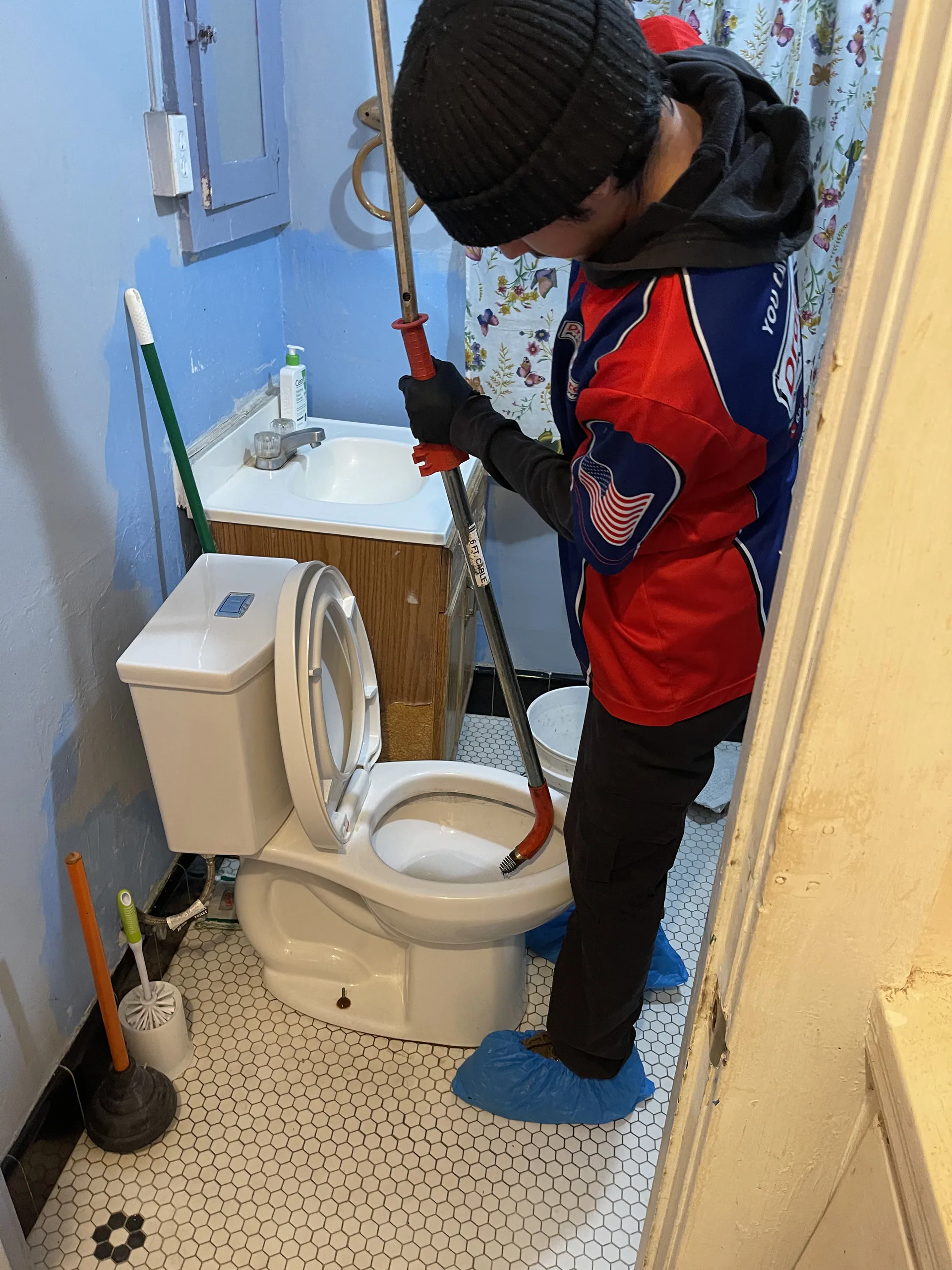
A plumber opens a wall and finds a damaged pipe.
The homeowner immediately wonders whether every pipe in the house is about to fail.
That conclusion may be too large.
An isolated fitting, damaged section, accidental puncture, or localized corrosion may justify a focused repair. A whole-home repipe becomes a stronger consideration when the problem is not one location but a pattern across the water-supply system.
We provide both ordinary plumbing repair and whole-home repiping. Our repiping work begins with an analysis of the home's needs and a written proposal rather than treating every leak as an automatic replacement project.
Your repair history is often one of the most useful parts of that analysis.
Start with the location of the leak
Ask what failed. Was it a fixture supply line, a shutoff valve, a threaded connection, a soldered joint, a section damaged by a nail or screw, a pipe inside a wall, a slab or underground line, a main water service, a drain pipe, or a sewer line?
These do not all belong in the same repiping conversation.
Whole-home repiping generally refers to replacing water-supply piping throughout the property. A sewer line, drain branch, water service, or fixture connector may require a separate repair method.
We list repiping, water-line repair, sewer-line repair, drain clearing, and trenchless sewer work separately for that reason. A buried sewer problem should not be confused with failing interior water-supply piping.
Count repairs by system, not only by invoice
Five plumbing invoices do not necessarily mean the house has five failures in the same pipe system. One may be a toilet repair. Another may involve the water heater. A third may be a kitchen drain clog. Those do not establish that the supply piping is failing throughout the house.
Build a more useful history. For every leak or pipe repair, record the date, room, pipe type, whether it was a hot or cold line, the visible cause, the repair performed, whether wall or slab access was needed, whether corrosion was noted elsewhere, whether the same material remains, and any photographs.
A pattern of leaks in similar material across unrelated rooms carries more weight than several unrelated plumbing calls.
Look for conditions beyond active leaks
A repipe evaluation should consider how the supply system behaves even when no water is visibly escaping. Tell us about discolored water, metallic taste or odor, pressure changes, weak flow at several fixtures, flaking or visible corrosion, repeated pinhole leaks, temperature changes when several fixtures run, noisy piping, previous partial repiping, old abandoned lines, and water damage in multiple areas.
No single symptom proves the entire house needs replacement. Several related symptoms can justify a broader inspection.
A partial repipe can complicate the material history
Many older San Gabriel Valley homes contain more than one generation of plumbing. A kitchen was remodeled and received new piping. A bathroom addition used another material. One accessible section was replaced after a leak, while concealed piping remained original.
That history matters. We should identify which material is present, where it transitions, which sections are known to be newer, which areas remain original, whether previous repairs used compatible connections, whether the main service is part of the proposed work, whether exterior hose connections are included, and whether fixture shutoffs are being replaced.
A proposal stating "whole-home repipe" should define the limits. You should not assume every pipe from the street to every drain is included.
Pressure deserves measurement
Excessive or unstable pressure can contribute to plumbing stress. Low pressure may also result from several causes, including restrictions, valves, service-line conditions, or fixture-specific problems.
Ask whether pressure was measured and what the result means for the proposed work. If pressure control or another system component needs attention, the proposal should identify it separately rather than assuming new piping alone addresses every condition.
Plan wall access before approving the project
A repipe involves concealed routes. The estimate should describe where we expect to access the system and what restoration is included.
Ask which walls or ceilings may be opened, whether closets or cabinets can provide access, whether piping will travel through the attic, whether slab work is expected, whether exterior routes are being considered, who closes drywall, who matches texture and paint, whether cabinets or tile are affected, whether the family can remain in the house, and how long water will be unavailable.
This article addresses the earlier decision: whether the pattern justifies repiping in the first place. The access plan belongs in the written scope before work begins.
Compare another repair with the broader system cost
A spot repair may cost less today. That does not automatically make it the worse choice.
The right comparison should include the condition of surrounding pipe, the number of prior failures, access cost, damage already created, the likelihood that the repaired section is unusual, the age and material of the rest of the system, planned remodeling, the time you expect to remain in the home, budget, and the disruption of a larger project.
We can explain the physical condition and scope. You still make the financial and household decision.
Get the proposal boundaries in writing
Our repiping process includes an analysis of the installation needs, personalized options, financing availability when it fits, and a written scope. Current promotional terms may change and should be confirmed when scheduling through contact us or our current offers page.
The written proposal should state whether it includes hot and cold distribution, the main shutoff, fixture connections, hose bibs, water-heater connections, a pressure regulator, insulation, pipe supports, permitting or inspection, wall repair, cleanup, warranty documentation, and removal of abandoned material where practical.
We have served the San Gabriel Valley since 1996 and hold California contractor license #803591. We dispatch from Walnut and serve Covina, West Covina, Glendora, Pomona, Chino Hills, and nearby communities. Call (626) 332-9984 for plumbing repair and repiping evaluations. More related reading is on the blog.